

Wild Forest Honey vs Market Honey: What Makes Them Truly Different?
By oregion foodsHoney is more than just a sweetener; it is a reflection of nature, the environment, and processing methods. Yet, when most people search for Honey, they often compare only price or packaging. The real difference lies deeper, in purity, sourcing, and nutritional value.
At oRegion, we believe that understanding the difference between Wild Forest Honey and market honey helps you make smarter, healthier choices. Whether you’re searching for Pure Honey Online, trying to understand how to determine pure honey, or looking for the Best Raw Honey, this guide will give you clear, practical answers.
Wild Forest Honey vs Market Honey: A Clear, Honest Comparison
When people search for honey, they often focus on price or brand, but the real difference lies in how the honey is sourced, processed, and preserved. Understanding this distinction helps you choose between Wild Raw Honey and conventional market options based on quality, health benefits, and intended use.
This guide is structured to give clear answers while helping users make confident decisions.
What Is Wild Forest Honey?
Definition and Origin
Wild Forest Honey is a type of natural honey collected from Rock bees (Apis Dorsata) that roam freely in forests. These bees gather nectar from a wide variety of wild plants, herbs, and trees, far from industrial farming and chemical exposure.
Unlike commercial farming, this honey reflects true biodiversity. Each drop of Natural Wild Honey carries the essence of multiple floral sources.
Why It Is Considered the Best Raw Honey
Wild Forest Honey is often categorized as the Best Raw Honey because:
-
It is usually unprocessed and unheated
-
It retains enzymes, pollen, and antioxidants
-
It comes from diverse flora, boosting nutritional richness
This makes it a preferred choice for those searching for Raw Natural Honey or Organic Pure Honey.
Key Characteristics
-
Darker color and thicker texture
-
Strong, earthy, sometimes herbal flavor
-
Seasonal availability depending on forest cycles
This uniqueness is why many health-conscious buyers consider it the Best and Pure Honey.
Read More: How oRegion's Natural Honey Supports Cruelty-free Practices
What Is Market Honey?
Definition and Production
Market honey refers to honey widely available in supermarkets and online stores. It is usually produced in large-scale apiaries where bees collect nectar from single crops like mustard or clover.
This type of honey is designed for mass consumption and convenience.
Why It Is Widely Available
Market honey dominates shelves and online platforms because it is designed for mass production and consistent supply. Large-scale beekeeping operations place hives near specific crops, allowing bees to collect nectar in controlled environments.
-
Produced in large quantities: Commercial apiaries manage thousands of hives, ensuring continuous output.
-
Processed for longer shelf life: Heating and filtration help prevent fermentation and delay crystallization.
-
Filtered for a clean and clear appearance: Consumers often associate clarity with purity, so brands refine honey for visual appeal.
Because of these factors, market honey easily ranks in searches like Pure Honey Near Me, as it is readily available across supermarkets, e-commerce platforms, and local stores.
Common Features
Market honey is engineered for consistency, which is why it appeals to everyday consumers:
-
Light golden color: Achieved through filtration and blending.
-
Mild, consistent taste: Comes from single-source nectar, making it predictable.
-
More affordable compared to Wild Forest Honey: Lower production costs make it budget-friendly.
This reliability makes market honey a practical choice for daily consumption, tea, baking, and cooking.
Read More: Choose Pure Honey & Jaggery: Avoid Adulteration
Core Differences Between Wild Forest Honey and Market Honey
Source of Nectar
Wild Forest Honey
Wild Forest Honey is collected from bees that forage across forests rich in the source of wild forest honey, such as Neem, Mahua, Karanj, Hirda, Behda, and other medicinal plants. This creates a naturally complex multiflora honey with diverse nutrients.
Market Honey
Market honey is usually derived from monoculture crops like mustard, eucalyptus, or clover, limiting its nutritional diversity.
Impact on Quality
The diversity of nectar sources directly affects quality. A wide range of floral inputs results in:
-
Higher micronutrient diversity
-
More complex flavor profiles
-
Enhanced health benefits
That’s why Raw Multiflora Honey is often considered superior when compared to single-source honey.
Processing Methods
Wild Raw Honey
Wild honey typically undergoes minimal human intervention, preserving its natural integrity:
-
Minimal filtration to remove visible impurities
-
Minimal heat processing, protecting enzymes
-
Retains pollen, antioxidants, and bioactive compounds
This makes it highly suitable for people searching for Raw Organic Honey, Raw Honey Online, or Raw Natural Honey.
Market Honey
Commercial honey is processed for stability and appearance:
-
Pasteurized at high temperatures to kill yeast and extend shelf life
-
Ultra-filtered to remove particles and improve clarity
-
Designed to remain smooth and liquid for longer periods
Why Processing Matters
Processing significantly impacts nutritional quality. Heat and filtration can:
-
Destroy natural enzymes
-
Reduce antioxidant levels
-
Remove pollen (a key indicator of origin)
This is why consumers researching how to identify pure honey often prefer raw and unprocessed varieties over heavily refined ones.
Read More: Honey & Weight Loss: What You Need to Know
Nutritional Value
Wild Forest Honey
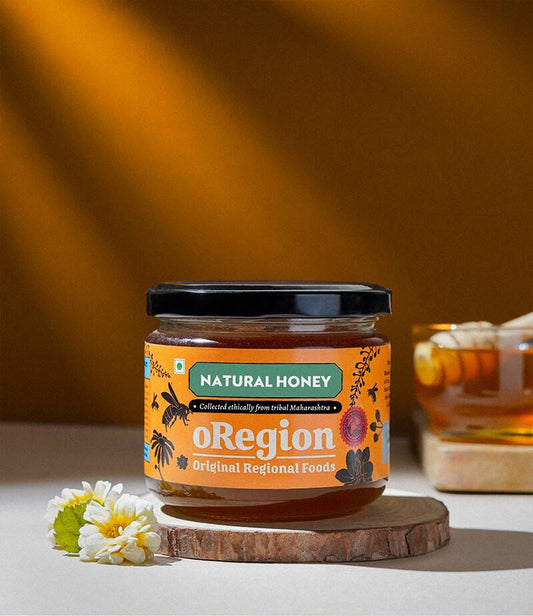
Wild Forest Honey from oRegion represents honey in its most natural and unaltered form. Unlike commercial varieties, it is not just a sweetener—it is a nutrient-rich natural food created through the interaction of bees with diverse forest ecosystems.
Bees collect nectar from medicinal herbs, wildflowers, and forest trees, resulting in Natural Raw Multiflora Honey that carries a wide spectrum of bioactive compounds. This diversity is what makes Raw Multiflora Honey nutritionally superior.
-
High antioxidant levels: Wild Forest Honey contains flavonoids and polyphenols that help neutralize free radicals. These compounds play a key role in supporting immunity, slowing aging processes, and protecting cells from damage.
-
Rich in trace minerals: It naturally contains iron, zinc, potassium, calcium, and magnesium, which support metabolism, bone health, and overall vitality.
-
Natural antibacterial properties: Enzymes like glucose oxidase produce hydrogen peroxide, making Raw Natural Honey effective in fighting harmful bacteria.
-
Anti-inflammatory effects: Regular consumption may help reduce internal inflammation and support recovery from infections or fatigue.
Because it is minimally processed, Raw Organic Honey retains these nutrients in their active form. This is why it is widely considered the Best Raw Honey and a top choice for those searching for the best and Pure Honey.
Market Honey
Market honey is still derived from natural sources, but its processing significantly influences its final nutritional value.
-
Lower antioxidant content: Pasteurization involves heating, which destroys heat-sensitive enzymes and antioxidants.
-
Possible dilution or adulteration: In low-quality variants, sugar syrups may be added, reducing purity and health benefits.
-
Limited micronutrient diversity: Since it is often sourced from a single crop, it lacks the broad nutrient profile found in multiflora honey.
That said, not all market honey is poor. Some premium brands offering Raw Honey Online or Pure Honey Online provide better-quality options that retain partial nutritional value when minimally processed.
Read More: Honey for better sleep: how it works and how to use it?
Health Impact
When comparing overall health benefits, forest honey benefits are significantly more pronounced due to higher nutrient density and natural integrity.
Regular use of Raw Natural Honey can support:
-
Stronger immune system: Antioxidants help the body fight infections and improve resistance.
-
Better digestion: Natural enzymes aid in breaking down food and maintaining gut balance.
-
Sustained natural energy: Unlike refined sugar, honey provides a gradual release of energy without sudden crashes.
-
Respiratory relief: Traditionally used in Indian households to soothe cough, throat irritation, and seasonal allergies.
Because of these benefits, health-conscious consumers actively prefer Organic Pure Honey, Natural Wild Honey, and Best Honey options over heavily processed alternatives.
Appearance and Texture
Wild Forest Honey
The appearance of Wild Forest Honey reflects its purity and natural origin. Unlike standardized commercial products, it varies depending on season, floral source, and region.
-
Darker color: Indicates higher mineral and antioxidant content.
-
Texture: from lower viscosity to thick texture, based on season and temperature
-
Natural variation: Each batch of Natural Raw Multiflora Honey may look slightly different.
-
Crystallization over time: A natural and healthy transformation process.
This natural inconsistency is actually a sign of authenticity and is commonly seen in Best Raw Honey.
Market Honey
Market honey is processed to maintain a consistent and attractive appearance:
-
Clear and bright look: Achieved through fine filtration.
-
Smooth and uniform texture: Designed to match consumer expectations.
-
Remains liquid longer: Heat processing delays crystallization.
-
Market honey is thicker and more consistent over time
While visually appealing, this uniformity often comes at the cost of reduced natural properties.
What Crystallization Means
Crystallization is one of the most misunderstood characteristics of honey. In reality, it is a positive indicator of purity.
It shows that the honey is:
-
Less processed and closer to its natural form
-
Rich in natural glucose content
-
Free from excessive heating and chemical alteration
If you are learning how to recognise pure honey, crystallization is one of the simplest and most reliable indicators. Pure honey naturally crystallizes over time, while highly processed honey is designed to remain liquid artificially.
Read More: Difference Between Honey and Honey Pollen Explained
Comparison Table for Quick Understanding
Wild vs Market Honey Overview
|
Feature |
Wild Forest Honey |
Market Honey |
|
Source |
Multi-floral forest |
Single crop |
|
Processing |
Raw, minimal |
Heated, filtered |
|
Nutrients |
High |
Moderate |
|
Taste |
Complex, bold |
Mild, consistent |
|
Texture |
Thick, may crystallize |
Smooth, liquid |
|
Availability |
Seasonal |
Year-round |
|
Honey Price |
Higher |
Affordable |
This comparison clearly explains why Wild Forest Honey is often chosen by those searching for Best Raw Honey, Raw Natural Honey, or Organic Honey Online.
Is All Market Honey Bad?
Understanding Quality Variations
It is important to clarify that not all market honey is bad. With increasing awareness, many brands now offer Raw Honey Online and improved-quality products.
However, the market still includes:
-
Products labeled as Pure Honey but heavily processed
-
Blended honey with added sugars
-
Low-cost options that compromise quality
Only a few brands maintain true authenticity similar to Natural Wild Honey.
What to Look for on Labels
When buying Pure Honey Online or searching for Pure Honey Near Me, always check for:
-
Raw (minimal processing)
-
Unfiltered (retains nutrients and pollen)
-
Unpasteurized (no heat damage)
-
No added sugar or syrups
These indicators help ensure you are buying Original Honey rather than a refined substitute.
Smart Buying Tip
If you want to truly understand how to identify original honey, follow these practical steps:
-
Carefully read ingredient labels
-
Check the source (forest-based or farm-based)
-
Avoid extremely low-priced options
-
Prefer trusted brands like oRegion that provide transparency
In today’s market, awareness is the key to finding Best and Pure Honey.
How to Choose the Best Honey for Your Needs
Based on Health Goals
For Immunity and Medicinal Use
Choose Wild Forest Honey, as it offers stronger forest honey benefits due to its antioxidant-rich composition.
For Daily Use and Cooking
Market honey can be a practical option, if it is genuine Pure Honey without additives.
Based on Taste Preference
Strong and Earthy Flavor
Wild honey delivers bold and complex flavors, ideal for those who enjoy Natural Raw Multiflora Honey.
Mild and Sweet Flavor
Market honey offers a lighter, more consistent taste suitable for regular use.
Based on Budget
Premium Segment
Wild honey is priced higher due to:
-
Limited availability
-
Natural harvesting
-
Minimal processing
Budget-Friendly Options
Market honey provides affordable alternatives for everyday use.
Buying Guide – Honey Online and Offline
Key Factors to Consider
Source Transparency
Always choose honey with clear sourcing, especially forest-based products like Wild Forest Honey.
Processing Method
Look for labels such as Raw Natural Honey or minimally processed honey.
Price vs Quality
Very cheap products, especially in honey combo pack deals—may indicate dilution.
Best Practices for Online Purchase
Read Reviews
Customer feedback helps identify the Best Honey.
Check Certifications
Important when searching for Organic Honey Online.
Compare Products
Evaluate multiple honey combo options to find the best value.
Benefits of Choosing Natural Honey
Health Advantages
Supports Immunity
Rich in antioxidants, especially in Wild Forest Honey.
Aids Digestion
Supports gut health and improves digestion naturally.
Provides Natural Energy
Acts as a healthier alternative to refined sugar.
Long-Term Value
Better Nutritional Intake
Provides more nutrients compared to processed sweeteners.
Reduced Chemical Exposure
Especially important when choosing Organic Pure Honey.
How to Determine Pure Honey
Understanding how to determine pure honey is essential for making informed decisions.
Simple Ways to Identify Pure Honey
-
Water Test: Pure honey settles at the bottom without dissolving quickly
-
Thumb Test: It remains intact and does not spread easily
-
Crystallization: A natural sign of authenticity
These methods answer common queries like How to Identify Pure Honey and how to identify original honey.
Common Myths
-
Clear honey is not always pure
-
Thick honey does not guarantee authenticity
-
High price does not always mean better quality
Learning how to recognise pure honey requires awareness and correct knowledge.
Final Decision Guide
When to Choose Wild Forest Honey
-
You prioritize health and nutrition
-
You prefer raw, unprocessed foods
-
You want maximum forest honey benefits
When to Choose Market Honey
-
You need a cost-effective option
-
You prefer consistent taste
-
You use honey mainly for cooking
Conclusion: Choosing the Best Honey for You
Key Takeaway
The difference between Wild Forest Honey and market honey lies in purity, sourcing, processing, and nutritional value. While both types serve different needs, their long-term impact on health is not the same.
Final Insight
If your goal is to consume honey in its most natural and beneficial form, choosing Raw Multiflora Honey, Natural Wild Honey, or Organic Pure Honey from trusted brands like oRegion is the smarter decision. These options deliver real nutrition, authenticity, and long-term health benefits.
On the other hand, if convenience and affordability are your priorities, carefully selected market honey can still serve your needs, but it requires careful label checking and awareness.
Action Step
Before buying your next jar of honey, ask yourself:
-
Are you choosing based on health or price?
-
Do you understand how to identify pure honey?
-
Have you checked for raw and unprocessed labels?
Whether you choose a honey combo pack, explore Raw Honey Online, or look for Pure Honey Near Me, making an informed decision ensures you get the Best and Pure Honey that truly supports your lifestyle, health, and well-being.
Follow us for more wellness tips
👉 Buy Now on oregion.in
📸 Instagram: @oRegion.in
📘 Facebook: facebook.com/oRegionfoods
▶ YouTube: https://www.youtube.com/@oRegion_foods
👉 Shop Globally on Distacart & PushMyCart