


Do you think food purity and safety are the same?
By oregion foodsTwo different questions, answered by two different tests. Most labels answer neither.
Written by Rajat Nikhade, who started oRegion with Mayank Jadhao. Chemical engineering graduate, Institute of Chemical Technology (ICT) Mumbai, with five years in R&D, operations and quality management.
No. Pure food and safe food are two different things, and a product can be one without being the other.
Purity is about what went in. Safety is about how it was handled. A jar of honey can contain nothing but honey and still have been filled in a room where nobody washed their hands. A bag of flour can be entirely unadulterated and still carry mould from a damp warehouse. Neither problem shows up in a purity test, because a purity test is not looking for it.
Almost every label that says pure, natural or chemical free is talking about the first question. Very few brands ever answer the second one, and almost none publish the answer.
What does purity actually mean?
Purity testing looks for adulteration. It asks whether anything has been added that should not be there, usually because that thing is cheaper than the food it is hiding in.
Every food category has its own known adulterants. Milk gets water and starch. Spices get colour and filler. Honey gets sugar syrup. Ghee gets vanaspati. Edible oils get cheaper oils blended in.
Testing for these is well established, and the methods are specific. Ghee is screened with the Baudouin test, which detects sesame oil and is used as a marker for vanaspati. Edible oils are screened for argemone oil, an adulterant historically linked to outbreaks of epidemic dropsy in India, which is precisely why the test exists at all.
A purity result answers one question and answers it properly: is this actually what it says it is, and only that?
What purity testing cannot see
Here is the gap that matters.
Food can be completely genuine and still unsafe. It can be made in a facility with poor sanitation. It can be packed by someone with an infection. It can be stored somewhere warm and damp long enough for mould to establish. It can be filled using water that was never tested.
None of that involves adding anything. Nothing was adulterated. And none of it would appear in a purity report, because purity testing looks for foreign substances, not for the conditions the food passed through.
That is what microbiological testing is for. It is a different section of a different discipline, and it is the section most brands never run.
What safety testing actually checks
Five parameters do most of the work, and the permitted limits matter as much as the results.
Total plate count: A broad count of viable microorganisms. It does not identify any specific organism. What it tells you is how hygienic the whole operation was across processing, handling and storage. A high count is a general warning rather than a specific one.
Yeast and mould: These affect shelf life and stability. A high count is an early signal that a product may spoil or deteriorate before its stated expiry, even if it looks and smells fine on the day you open it.
Staphylococcus aureus: Associated with human handling. Its presence usually points to hygiene failures at the packing stage: hands, surfaces, equipment.
E. coli: Points to problems with water, sanitation or handling. Its presence in food is a serious concern.
Salmonella: A foodborne pathogen capable of causing illness. Its absence is not a bonus feature. It is a baseline requirement.
None of these five is answered by asking whether a food is pure.
What our own reports showed
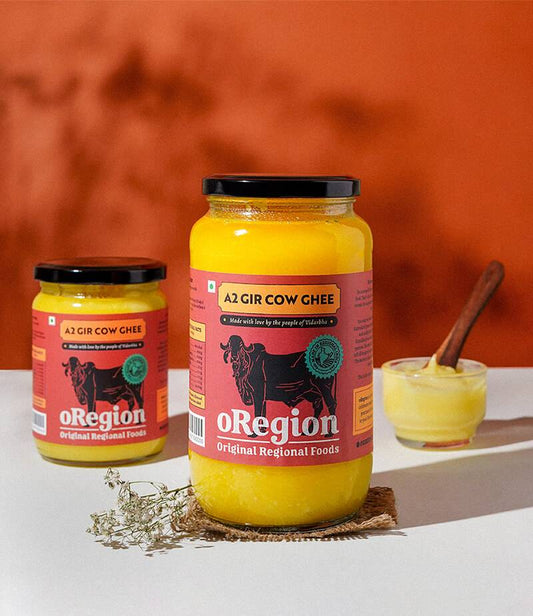
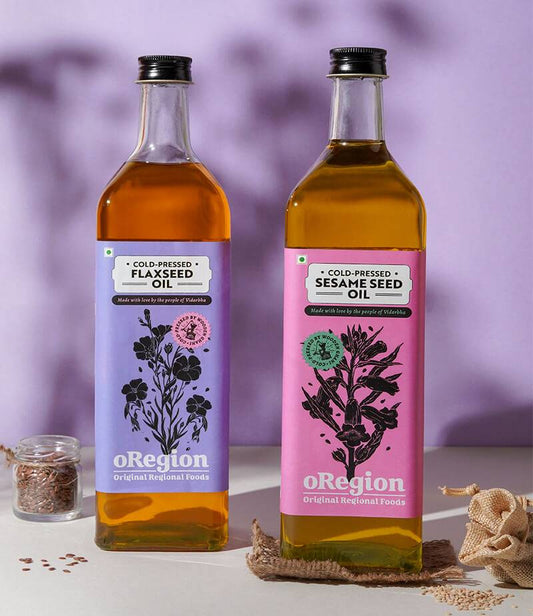
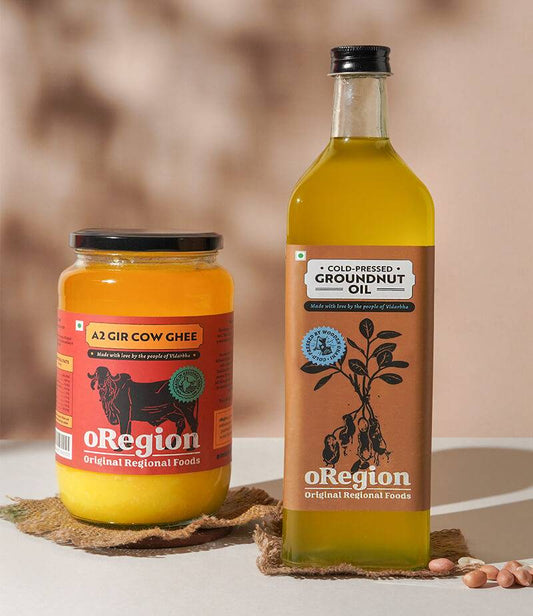
We recently had both our cow ghee and our flaxseed oil tested on chemical and biological parameters at a NABL accredited laboratory. Here is what came back, with the permitted limits alongside, because a result without its limit is a number without meaning.
Cow ghee, biological
Total plate count came in at 20 CFU per gram, against a permitted maximum of 100,000. Yeast and mould came in under 10, against a limit of 100. Staphylococcus aureus, E. coli and Salmonella were all absent.
Cow ghee, chemical
Turmeric and starch were both absent. The Baudouin test was negative. Reichert Meissl value came in at 28.69 against a minimum of 26.0. Moisture was 0.10 percent against a maximum of 0.5, and free fatty acid 0.43 percent against a maximum of 2.0.
Flaxseed oil
Total plate count of 5 CFU per millilitre against the same 100,000 limit, yeast and mould under 1, and the same three pathogens absent. On the chemical side, the argemone oil screen came back absent, iodine value was 177.83 against a minimum of 170.0, and acid value 1.45 against a maximum of 4.0.


The number sitting at the edge of its range
One result is worth pointing at, because it shows something a marketing claim never will.
The butyro refractometer reading on our ghee came back at 40.0, against a specified range of 40.0 to 43.0. It passes. It also sits at the very bottom of the band.
That reading relates to the composition of the fat, and it moves with what the cattle were eating and when. The standard itself takes this for granted. Permitted ranges for ghee in India are written differently for different regions, and the standard even separates cotton growing tracts from non cotton tracts within Maharashtra. Ours is measured against the Maharashtra non cotton tract band, because that is where our cattle are.
Two things follow.
First, natural products vary. A value that sits mid range in one season can sit near the edge in another, and that is expected rather than alarming.
Second, and this is the real point: one test describes one sample. A brand quoting a report from two years ago is telling you about a batch you will never receive.
What neither test tells you
Being straight about what we did not measure.
These reports do not cover pesticide residues or heavy metals. They do not measure vitamin content or give a full fatty acid breakdown. And they describe the samples submitted on those dates, nothing beyond that.
There is no single test that certifies a food as safe. There is only the right set of parameters for the risks that actually apply to that food.
How to read any brand's lab report
Five checks, and they work on ours as well as anyone else's.
Is the laboratory accredited?
Look for NABL accreditation and a reference to ISO/IEC 17025. Without it, the report is a document rather than a credential.
Is there a ULR number?
Accredited reports in India carry a Unique Laboratory Report number. It means the report is traceable in the laboratory's own system and can be checked rather than taken on trust.
Is there a biological section?
If the report is purity only, the hygiene question has not been asked.
Are limits shown next to results?
Twenty CFU per gram means nothing until you know the ceiling is 100,000.
What is the date, and which batch?
The most useful question, and the one most reports handle the worst.
One thing we are changing
Our reports say "Batch No/Lot No" followed by a dash.
The tests are real, the laboratory is accredited, the numbers are what they are. But neither report is tied to a production batch, which means we cannot point you at the jar it came from.
That is a gap, and it is an awkward one to admit in a piece arguing that consumers should ask harder questions. From the next round of testing, every report will carry a batch number so it can be linked to the bottle it describes.
Writing that down publicly is the simplest way to make sure it happens.
Questions we get asked
Does 100% pure mean a product has been lab tested?
No. It is a marketing phrase, not a certification. Ask what was tested, by which laboratory, and when.
How often should a brand test?
Per batch is the meaningful answer for a natural product, because natural products vary. Testing once a year tells you about one day.
Can I verify a lab report myself?
Yes. Check for the accreditation and the ULR number, then contact the laboratory if you want it confirmed. That is what the number is for.
Why do permitted ranges differ by region?
Because feed and climate change the composition of milk fat. Indian ghee standards are written with regional bands for exactly this reason.
Is there one test that proves food is safe?
No. Safety is a set of questions matched to the risks of that specific food. Anyone offering a single certificate of safety is simplifying something that cannot be simplified.
The short version
Purity tells you what is in your food. Safety tells you how it was handled. They are separate questions and they need separate tests, and a label on the front of a jar answers neither.
Ask what was tested. Ask for the limits alongside the results. Ask which batch. A brand that can answer all three is telling you more than any claim ever will.
Follow us for more wellness tips
👉 Buy Now on oregion.in
📸 Instagram: @oRegion.in
📘 Facebook: facebook.com/oRegionfoods
▶ YouTube: https://www.youtube.com/@oRegion_foods
👉 Shop Globally on Distacart & PushMyCart